

How safety shapes the efficacy of pet odor sprays
TL;DR:
- Not all pet sprays are equally safe or effective, as ingredient safety directly impacts odor elimination results.
- Regulatory oversight by agencies like the EPA ensures products are tested for safety and efficacy, promoting transparency and trustworthy formulas.
Not all pet sprays are created equal, and that gap matters more than most pet parents realize. Walk down any pet store aisle and you’ll see dozens of sprays claiming to banish odors fast. But here’s what those labels rarely tell you: the safety standards behind a formula directly affect how well it actually works. A spray loaded with harsh chemicals or heavy fragrances might smell like it’s doing something, but it’s often just covering up the problem. In this article, we’ll break down how regulatory oversight, ingredient choices, and proper usage combine to deliver odor elimination that’s both safe for your fur babies and genuinely effective.
Table of Contents
- Why safety is the foundation of effective pet odor sprays
- How safe ingredients and formulas protect pets and homes
- The science behind odor elimination: Why efficacy depends on safety
- Safe practices for using pet sprays in multi-pet homes
- The uncomfortable truth about pet spray safety most brands ignore
- Explore safe, effective pet odor solutions for your home
- Frequently asked questions
Key Takeaways
| Point | Details |
|---|---|
| Safety drives efficacy | Regulatory safety standards directly improve how well pet sprays remove odors. |
| Ingredient transparency matters | Choosing sprays with clear, low-risk ingredient lists protects pets and homes. |
| Proper usage is crucial | Following dwell time and volume recommendations ensures permanent odor removal. |
| Source elimination wins | Targeting odor sources is far more effective than masking, especially in multi-pet households. |
Why safety is the foundation of effective pet odor sprays
Now that we’ve set the stage, let’s explore how safety really drives both peace of mind and odor removal power.
Most pet parents think of safety and effectiveness as two separate checkboxes. Safe product. Check. Does it work. Check. But the truth is, they’re deeply connected. A spray that cuts corners on safety almost always cuts corners on real performance too.
Here’s why that matters. The U.S. Environmental Protection Agency regulates many pet sprays under the Federal Insecticide, Fungicide, and Rodenticide Act, known as FIFRA. If a spray makes antimicrobial or odor-related claims that involve mitigating pests indirectly, the EPA requires registration to ensure no unreasonable adverse effects on people, pets, or the environment. That registration process forces manufacturers to prove both safety and efficacy through testing. No shortcuts allowed.
“A product that passes EPA safety benchmarks isn’t just safer for your pets. It’s been held to a higher standard of performance, too.”
There’s also a category called minimum risk exemptions. Certain products made with low-risk ingredients can be exempt from full FIFRA registration, but they still must meet defined benchmarks and cannot make unsubstantiated claims. This means even the “lighter” end of the regulatory spectrum has teeth.
Understanding pet cleaning safety standards helps you see why this matters for your home. When brands comply with these rules, they’re forced to be transparent about what’s in their formula and how it performs. That transparency is good for your pets and good for your results.
Here’s what safety-backed oversight actually delivers for you:
- Tested formulas. Registered products have documented proof that ingredients work as claimed.
- Ingredient accountability. Brands must disclose active ingredients, which lets you make informed choices.
- Reduced risk of harm. Regulated products are tested to ensure they won’t cause unreasonable harm to pets, people, or surfaces.
- Performance benchmarks. Safety testing often includes efficacy testing, so you’re not just getting a “safe” product. You’re getting one that actually performs.
When you prioritize pet safety for odor control, you’re not sacrificing results. You’re actually raising the bar for them. The brands that invest in safety compliance are the same ones investing in real odor elimination science.
How safe ingredients and formulas protect pets and homes
Understanding regulations is just the first step. Next, let’s examine what actually makes an ingredient safe for your pets.
The EPA uses specific language when classifying ingredients. “Minimum risk” ingredients are those with a well-established safety record, typically plant-derived or naturally occurring substances that pose little to no threat to humans or animals under normal use. These include things like citric acid, thyme oil, and certain essential oil derivatives. “Low risk” is a broader category that includes ingredients with limited toxicity profiles and no known bioaccumulation concerns.
What does this mean for your pets? It means a formula built on these ingredients is far less likely to trigger allergic reactions, cause skin irritation, or create problems if a curious cat or dog licks a treated surface. That last point is huge for multi-pet homes.

Here’s a quick comparison of common formula types and how they stack up:
| Formula type | Odor mechanism | Lick safe | Fragrance free | Dwell time needed |
|---|---|---|---|---|
| Enzyme-based | Breaks down organic matter | Sometimes | Often not | 15 to 30 minutes |
| HOCl (hypochlorous acid) | Kills bacteria causing odor | Generally yes | Yes | Short |
| Fragrance-based masking | Covers odor with scent | Rarely | No | None (not eliminating) |
| Proprietary enzyme-free | Targets odor at molecular source | Yes | Yes | Minimal |
According to NCBI research on cleaning and disinfection, enzyme-based sprays require a 15 to 30 minute dwell time for permanent elimination, and effective use is modeled at approximately 50 grams of product per stain to fully saturate the affected area. This is critical information that most brands bury in fine print or skip entirely.
Pro Tip: If a spray’s label doesn’t tell you how long to leave it on or how much to use, that’s a red flag. Real odor elimination requires real instructions.
Safe formulas also protect your home surfaces. Harsh chemicals can bleach fabrics, degrade carpet fibers, and leave residues that attract more dirt over time. A well-formulated, low-risk spray does the job without the collateral damage.
Here’s what to look for in a safe, effective formula:
- No artificial fragrances. Fragrances mask odors and can irritate sensitive respiratory systems in cats and dogs.
- No unnecessary enzymes if your pet is prone to grooming treated areas, since some enzyme formulas can cause mild GI upset if ingested in quantity.
- Clear ingredient disclosure. You should be able to read and understand what’s in the bottle.
- Fragrance-free options. These are better for pets with allergies and better for honest odor elimination.
Learning about protecting pets from chemicals is one of the smartest things you can do as a pet parent. And knowing how ingredients are classified gives you real power at the point of purchase.
The science behind odor elimination: Why efficacy depends on safety
With ingredient safety covered, it’s vital to connect it with how sprays actually work to remove odors, especially in real-world use.
Here’s the core science in plain terms. Pet odors, especially from urine, come from specific organic compounds. Uric acid crystals are particularly stubborn because they bond tightly to fibers and reactivate with moisture. To truly eliminate the smell, you have to break down or neutralize those compounds at the source. Covering them with fragrance does nothing to the underlying chemistry. The smell comes right back.
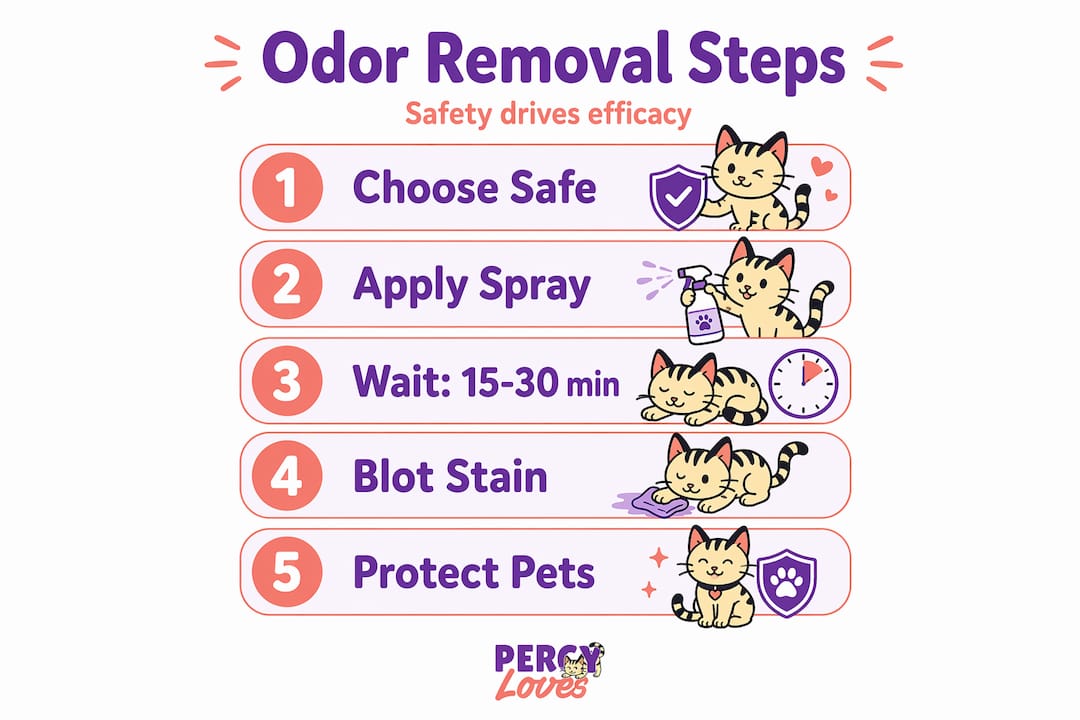
This is why dwell time matters so much. Enzyme-based sprays need 15 to 30 minutes of contact time to fully break down organic matter. Rushing the process means partial breakdown, which means the odor returns. Most pet parents don’t know this because brands don’t emphasize it enough.
Here’s a practical breakdown of how proper application drives results:
| Step | Why it matters | Common mistake |
|---|---|---|
| Saturate the stain fully | Reaches all layers of the substrate | Under-applying and missing the source |
| Allow full dwell time | Gives active ingredients time to work | Wiping up too soon |
| Blot, don’t scrub | Prevents spreading the stain | Scrubbing pushes odor deeper |
| Repeat if needed | Some stains need multiple treatments | Assuming one application is always enough |
The NCBI model for pet urine spray use is based on approximately 50 grams of product per stain, which is more than most people apply. Undersaturating is one of the top reasons odors return after treatment.
Here’s a step-by-step approach for best results:
- Blot up as much of the fresh stain as possible before applying any spray.
- Apply enough product to fully saturate the stained area, not just the surface.
- Allow the recommended dwell time without disturbing the area.
- Blot again with a clean cloth to lift the broken-down material.
- Allow the area to air dry completely before letting pets back on the surface.
- Repeat the process for older or set-in stains.
Following an odor control wellness guide can help you build these habits into your routine. And using pet-safe cleaning tips ensures you’re protecting your pets throughout the process.
The safety connection here is direct. Sprays built with safe, tested ingredients are also formulated with the right pH levels and concentrations to actually work. Unsafe or poorly regulated products often use ingredient ratios that either harm surfaces or fail to break down odor compounds fully. Safety compliance and real efficacy go hand in hand. Check out this effective pet cleaning guide for more on building a routine that works.
Safe practices for using pet sprays in multi-pet homes
Now that you know how sprays work, here’s how to apply them safely and effectively for best results at home.
Multi-pet homes face a unique challenge. More pets mean more odor sources, more surfaces to treat, and more curious noses and tongues investigating everything you spray. Getting the application right protects your pets and maximizes your results.
Here’s what to do before you ever pick up the spray bottle:
- Remove pets from the area. Give the product time to work without interference.
- Ventilate the space. Open windows or run a fan, even with fragrance-free products.
- Test on a small area first. Especially on delicate fabrics or wood finishes.
- Read the full label. Every product has specific instructions that affect both safety and performance.
One of the most important shifts you can make as a pet parent is moving away from masking sprays entirely. FIFRA-compliant products that meet safety benchmarks are designed for source elimination, not scent coverage. Experts consistently recommend source elimination over masking for long-term results, especially in homes with multiple pets where odor buildup compounds quickly.
After applying any spray, monitor your pets carefully:
- Keep them away from treated areas for at least 30 minutes.
- Watch for excessive grooming if they do access a treated surface.
- Note any signs of irritation like sneezing, pawing at the face, or watery eyes.
- If you’re using a lick-safe, fragrance-free formula, your risk window is much smaller, but caution is still smart.
Pro Tip: Set a timer when you apply a spray. It sounds simple, but most people forget and wipe up too early. Thirty minutes goes fast when you’re busy.
Following odor-free parenting best practices makes a real difference in how consistently you get results. It’s not just about the product. It’s about how you use it.
The uncomfortable truth about pet spray safety most brands ignore
Every tip and guideline above is essential, but there’s more to the story. Here’s what most brands won’t tell you.
We’ve seen a lot of pet sprays come and go, and the pattern is frustrating. Brands spend enormous energy on scent marketing. They want their product to smell like lavender or citrus or “fresh linen” because that smell signals clean to humans. But here’s the uncomfortable truth: that scent is doing the heavy lifting in your perception, not in actual odor elimination.
Fragrance is cheap. Real odor elimination science is not. When a brand invests in fragrance instead of formula, they’re betting that you’ll judge the product by how it smells in the moment rather than whether the odor comes back in two days. And most of the time, that bet pays off. Because most pet parents don’t connect the returning smell to the spray they used last week.
Ingredient transparency is another area where most brands fall short. They’ll list “proprietary blend” and call it a day. That tells you nothing about whether those ingredients are safe for a cat who grooms obsessively or a dog who immediately rolls on every surface you treat. You deserve better than that.
The brands worth trusting are the ones who tell you exactly what’s in the bottle, explain why it works, and give you real usage instructions. They don’t hide behind fragrance. They don’t bury dwell time requirements in microscopic font. And they don’t make you guess whether it’s safe if your pet licks the couch.
Prioritizing pet safety isn’t just a nice-to-have. It’s how you know a brand is actually committed to the thing they’re selling. Demand clear labels. Ask for safety data. Expect real instructions. Your pets are family, and they deserve a product built with that in mind.
Explore safe, effective pet odor solutions for your home
Having learned what safety really means, here’s where you can experience it directly for your pets and home.
At Percy Loves, we built Pal Furresher because Percy had a real funk problem and we couldn’t find a spray we actually trusted. Pal Furresher is fragrance-free, enzyme-free, and lick safe. Its proprietary formula tackles odors at the source, not just on the surface. No masking. No mystery ingredients. Just clean.
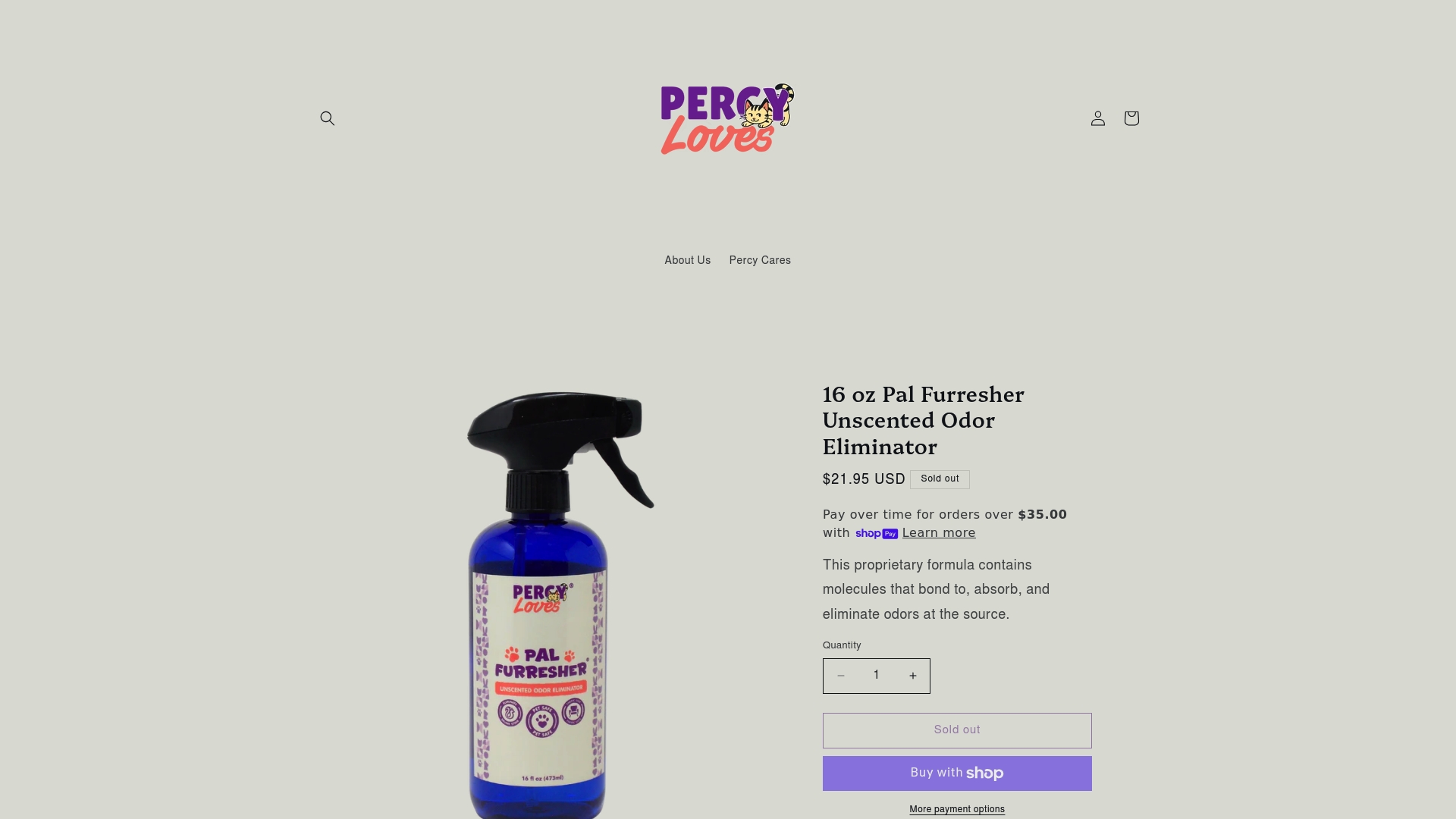
Whether you need a travel-friendly option or a bottle that keeps up with a multi-pet household, we’ve got you covered. The 4 oz unscented odor eliminator is perfect for on-the-go use and spot treatments, while the 16 oz unscented odor eliminator is built for homes where odor is a daily challenge. Both are formulated to meet the safety and efficacy standards we’ve talked about throughout this article. Because we believe safe and effective should always go together.
Frequently asked questions
What makes a pet spray “safe” for cats and dogs?
A safe pet spray uses ingredients recognized as low-risk by the EPA, avoids harmful chemicals, and complies with FIFRA to ensure no unreasonable adverse effects on pets or people.
How long should pet odor sprays be left on stains?
Enzyme-based sprays are most effective when left to dwell for 15 to 30 minutes on pet stains before blotting up.
Are unscented sprays safer and more effective than scented ones?
Yes. Unscented sprays avoid triggering allergic reactions and focus on eliminating odors at the source rather than covering them up, making them a better choice for sensitive pets.
What should I do if my pet licks treated areas after spray application?
Keep pets away from treated areas for at least 30 minutes after spraying, and choose a lick-safe, fragrance-free formula to minimize risk if accidental contact does happen.
What’s the difference between masking and eliminating odors?
Masking covers smells with fragrance while the odor source remains, while source elimination targets and neutralizes the actual compounds causing the smell for longer-lasting results.


