

Pet Safe Cleaning Explained: What Every Pet Parent Needs
TL;DR:
- Many cleaning products labeled as “pet safe” can still contain harmful ingredients, so always check the full ingredient list.
- Effective pet-safe cleaning relies on avoiding chemicals like bleach, phenols, glycol ethers, formaldehyde, synthetic fragrances, and certain essential oils, which can harm small animals and sensitive pets.
You read the label. It says “pet safe.” You buy it, clean your floors, and let your dog or cat wander right back in. Makes sense, right? Not always. Pet safe cleaning explained properly means going well beyond what a label says. Many products marketed as safe still contain ingredients that can irritate lungs, upset stomachs, or cause real harm, especially to smaller animals like rabbits, guinea pigs, and ferrets. This guide breaks down what truly makes a cleaner safe, what to avoid, and how to keep your home fresh without putting your fur family at risk.
Table of Contents
- Key Takeaways
- What makes a cleaning product truly pet safe
- Safe and effective alternatives that actually work
- Room-by-room cleaning strategies for pet homes
- Managing odors the pet-safe way
- My honest take on pet-safe cleaning
- Try Pal Furresher for real odor elimination
- FAQ
Key Takeaways
| Point | Details |
|---|---|
| Labels can mislead | “Pet safe” is not federally regulated, so always read the full ingredient list. |
| Grooming increases exposure | Pets lick their paws and coats, meaning floor residue goes straight into their bodies. |
| Steam cleaning works | Steam mops sanitize at 260°F with no chemicals, making surfaces safe immediately after use. |
| Unscented beats natural | Many natural or botanical cleaners contain oils that are toxic to cats and sensitive pets. |
| Odor at the source wins | Masking smells with sprays doesn’t solve the problem — eliminating odors at the source does. |
What makes a cleaning product truly pet safe
Here’s something that surprises a lot of pet parents: pet cleaners aren’t federally regulated for labeling. That means any brand can slap “pet safe” on a bottle without meeting a single safety standard. So what do you actually look for?
Ingredients to avoid completely:
- Bleach and ammonia — Both release fumes that irritate the respiratory system. Cats are especially sensitive. Even diluted bleach can be dangerous on surfaces pets walk on.
- Phenols — Found in some disinfectant cleaners and pine-scented products. Cats lack the liver enzyme needed to process phenols, making these compounds particularly toxic for them.
- Glycol ethers — Common in many multipurpose sprays. These can cause anemia and kidney damage with repeated low-level exposure.
- Formaldehyde — A known irritant found in some floor cleaners and disinfectants.
- Fragrances — Even when plant-derived, synthetic or concentrated fragrances can trigger asthma-like symptoms in small animals and cats.
- Certain essential oils — Tea tree oil, eucalyptus, and pine oil are regularly cited as toxic to pets, particularly cats. If you want to check safe thresholds for dogs specifically, this essential oil safety checklist is a good reference.
Why does this matter so much? Because pets spend most of their time at floor level. They walk on freshly mopped surfaces, then groom their paws. Whatever is on that floor goes directly into their body. A chemical that barely affects a human adult can hit a 5-pound rabbit or a cat very differently.
The “natural” or “green” label trap is real. Natural cleaners can contain essential oils like tea tree or pine that trigger asthma or poisoning, especially in cats. “Natural” does not equal safe for pets. Always read the ingredient list, not the front of the bottle.
Pro Tip: If an ingredient ends in “-ol” or “-ene,” look it up before using it around pets. Phenol, cresol, and benzene are examples that commonly appear in cleaning products under unfamiliar names.
Safe and effective alternatives that actually work
Good news: you don’t need a cabinet full of specialized products to clean safely. A few well-chosen solutions go a long way.
-
Diluted castile soap — This is a go-to for pet-safe floor cleaning. Use 0.5 oz per 2 gallons of water for a solution that cuts grime without leaving a harmful residue. It’s gentle, unscented when you choose the fragrance-free version, and safe for most surfaces.
-
Diluted white vinegar — Diluted white vinegar is safe for pets and effective at cutting grease and light odors. Mix 0.25 cups per gallon of water. One bonus: cats tend to dislike the smell, so they often avoid freshly cleaned areas until fully dry.
-
Steam mops — This is the method home cleaning experts are increasingly recommending for pet households. Steam mops reach 260°F, which eliminates 99.9% of bacteria without any chemicals at all. Surfaces are safe for pets to walk on once cool. No residue. No fumes.
-
Fragrance-free plant-based laundry detergents — Residue from conventional detergents can cause skin or respiratory irritation in pets who sleep on washed bedding. Switching to fragrance-free options is a small change with a real impact.
-
Plain warm water — For many light messes and daily maintenance, warm water with a microfiber mop is genuinely enough. You don’t need chemicals for every cleaning task.
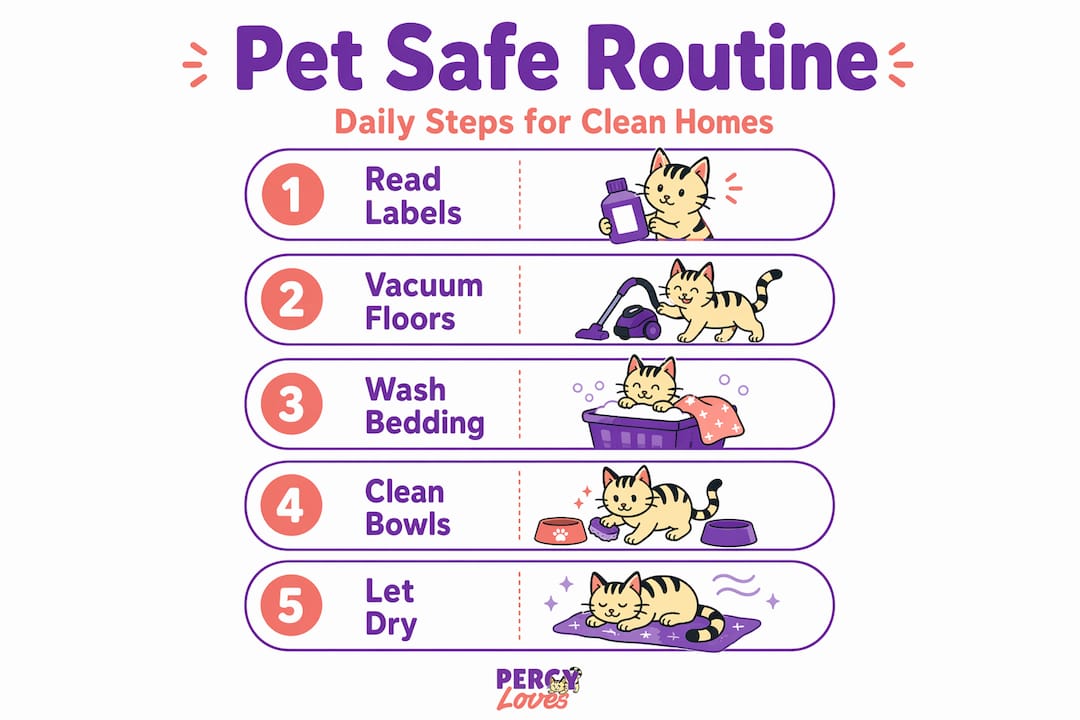
After any wet cleaning, always allow surfaces to dry completely before letting pets back in the room. Residue on floors from cleaning products gets ingested during grooming. Even a “safe” cleaner in large enough quantities can cause stomach upset or irritation.
Pro Tip: Keep a microfiber mop dedicated to your pet areas. Microfiber picks up more debris dry than most mops do wet, and it reduces how often you need any liquid cleaner at all.
Room-by-room cleaning strategies for pet homes
Cleaning safely isn’t just about what you use. It’s about where and how often.
Floors and rugs
Floors need the most attention because that’s where your pets live. Vacuum frequently, and professionally deep clean rugs every 6 months in pet households. Regular vacuuming helps but doesn’t reach the bacteria and dander embedded deep in carpet fibers. For hard floors, the diluted castile or vinegar solutions above work well. Always rinse with plain water after mopping and let everything dry fully.
Pet bedding and toys
Wash pet bedding weekly using fragrance-free, plant-based detergent. Skip fabric softeners entirely. They leave a coating on fabric that pets absorb through their skin and coat. For hard toys, warm water and a little castile soap, rinsed thoroughly, is all you need. You can find a full pet-parent cleaning checklist that covers laundering schedules and safe product swaps.
Feeding areas
Bowls should be washed daily with dish soap and hot water, then rinsed very well. The feeding area floor around bowls picks up food debris fast. Clean it with warm water and a tiny bit of castile soap, and dry it completely before putting bowls back.
Bathrooms and kitchens
These are the rooms where the most toxic products tend to live. Toilet bowl cleaners, drain cleaners, and oven sprays are among the most concentrated and hazardous products in the average home. Keep pets out of bathrooms and kitchens while cleaning and until surfaces are dry and well-ventilated.

Here’s a quick reference for cleaning frequency:
| Area | Recommended frequency | Method |
|---|---|---|
| Hard floors | Daily sweep, weekly mop | Diluted castile soap or steam mop |
| Rugs and carpets | Weekly vacuum, 6-month deep clean | Professional deep cleaning for pet homes |
| Pet bedding | Weekly | Fragrance-free plant-based detergent |
| Food bowls | Daily | Dish soap and hot water, rinsed well |
| Bathroom surfaces | After each use | Fragrance-free spray, ventilate before pets enter |
Pro Tip: Indoor air can be 5 times more polluted than outdoor air when VOC-heavy cleaners are used regularly. Opening windows during and after cleaning makes a real difference for both you and your pets.
Managing odors the pet-safe way
Odor is usually the reason pet parents reach for the strongest cleaner they can find. The problem is that most odor products, sprays, plug-ins, and scented candles just cover up the smell. The source is still there, and now you’ve added more chemicals to the air.
Real odor control means getting to the source.
- Remove the mess completely first. Whether it’s urine, feces, or vomit, lift and wipe away everything you can before treating the area.
- Avoid air fresheners and scented sprays. Many contain phthalates and synthetic fragrances that are hard on pet respiratory systems. For small animals like chinchillas, degus, and hedgehogs, even light fragrance exposure can cause distress.
- Use a non-toxic, fragrance-free odor eliminator. This is where non-toxic odor solutions that work at the molecular level change the game. Instead of layering scent on top of a problem, they bond to odor molecules and eliminate them.
- Improve ventilation. Fresh air is underrated. Running fans and opening windows regularly reduces the buildup of pet odors and indoor air pollutants.
- Wash fabrics often. Odor clings to soft surfaces. Curtains, throw blankets, sofa covers, and pet beds absorb smell quickly. Regular washing removes it instead of letting it build up.
That’s exactly the approach Percy Loves took when building Pal Furresher. Percy is a real cat with real funk. The humans at Percy Loves wanted something that actually worked, without fragrance, without harsh chemicals, and without anything that would be risky if Percy licked it. Pal Furresher is fragrance-free, enzyme-free, and lick-safe. It works on contact, bonding to and absorbing odor at the source to eliminate it completely. Not mask it. Eliminate it.
Pro Tip: For pet accident spots on upholstery or carpet, blot up as much liquid as possible first, then apply your odor eliminator directly. Letting it sit on the surface for a minute before blotting gives it time to bond to the odor molecules.
My honest take on pet-safe cleaning
I’ve talked with a lot of pet parents over the years who were genuinely doing their best. They bought the “natural” spray, the plant-based cleaner, the green-labeled mop solution. And still, their cat had recurring sneezing fits. Their rabbit seemed off. Their dog kept licking the floors obsessively after cleaning.
What I’ve found is that most pet owners underestimate the grooming risk. They think of cleaning as a surface issue when it’s really an ingestion issue. Every drop of product left on a floor is a product their pet could eat.
My honest take: the safest home is a low-product home. Steam clean when you can. Use fragrance-free everything. And for odor control, use something that’s genuinely designed to eliminate, not cover. Unscented, non-toxic, and lick-safe aren’t just nice-to-haves. For pets with sensitive systems, especially cats and small animals, they’re the standard to hold everything to.
The cleaning industry is slowly catching up to what pet parents actually need. But until labeling is regulated, the responsibility is on us to read labels, question claims, and choose products we’d feel comfortable with even if our pet walked right through them.
— Kathy
Try Pal Furresher for real odor elimination
If you’re ready to stop guessing what’s safe and start using something you can trust, Pal Furresher from Percyloves was made for exactly this. It’s fragrance-free, enzyme-free, and lick-safe. Its proprietary formula works on contact to bond to, absorb, and completely eliminate odors at the source, no masking, no harsh chemicals, no stress about what your pet might lick off the floor.
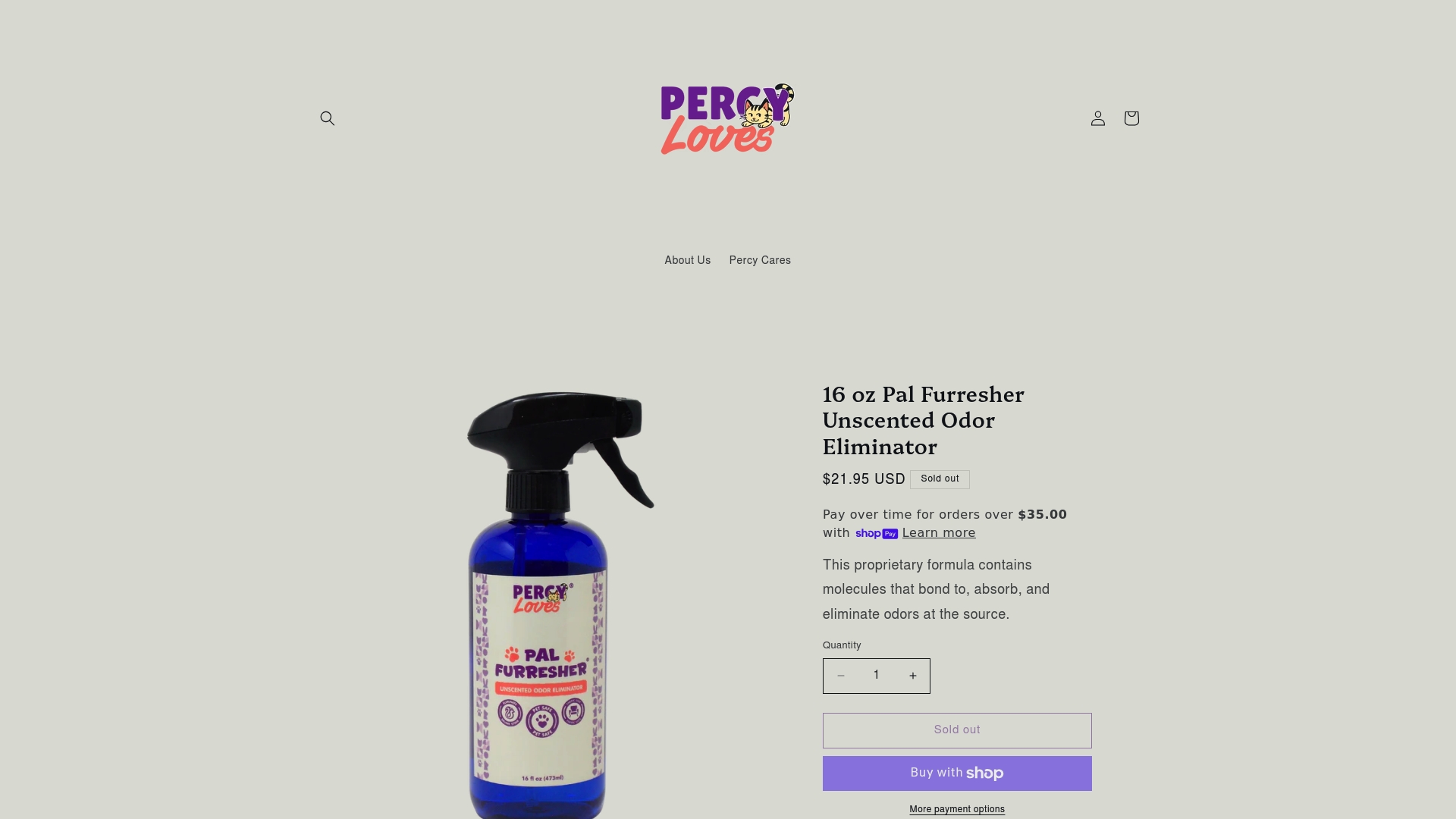
Percy started it. Real cat, real funk, real solution. Whether you need a 4 oz bottle for spot treating or a 16 oz bottle for whole-home use, Percyloves has you covered. Safe for dogs, cats, rabbits, guinea pigs, ferrets, and all the small animals you love. Check out the full non-toxic pet care guide on the Percyloves site to learn more about keeping your home safe from top to bottom.
FAQ
What does “pet safe” actually mean on a cleaning label?
“Pet safe” is not a regulated term, so it doesn’t guarantee safety. Always read the ingredient list and avoid phenols, ammonia, bleach, and synthetic fragrances.
Are natural or plant-based cleaners always safe for pets?
No. Many natural cleaners contain essential oils like tea tree and pine that are toxic to cats and can trigger respiratory issues in other pets. Always check individual ingredients.
How soon can my pet return to a freshly cleaned area?
Wait until the surface is completely dry and the room is well-ventilated. Residue left on floors can be ingested during grooming and cause stomach upset or irritation.
Is fragrance-free the same as unscented?
Not exactly. “Unscented” products sometimes contain masking agents to neutralize odors. True fragrance-free products contain no scent ingredients at all, which is the safer choice for sensitive pets.
What is the safest way to eliminate pet odors without harsh chemicals?
Remove the mess fully, then use a non-toxic, fragrance-free odor eliminator that works at the source rather than covering up the smell. Improve ventilation and wash fabrics regularly to prevent odor buildup.


