

How to entertain indoor cats and keep them happy
TL;DR:
- Indoor cats are not lazy but are miniature predators confined to apartments, leading to boredom without proper stimulation. Providing enrichment through vertical spaces, interactive play, and consistent routines satisfies their natural hunting instincts and improves their behavior and well-being. Properly ending play cycles by allowing cats to “catch” toys and immediately rewarding them with food is crucial for fulfilling their instincts.
Your indoor cat is not bored because they’re lazy. They’re bored because they’re a miniature predator living in an apartment. Knowing how to entertain indoor cats properly goes far beyond tossing a crinkle ball across the floor. Without the right stimulation, cats develop real behavioral problems: over-grooming, aggression, incessant yowling, and furniture destruction that would make you cry. The good news? You don’t need a big space or an expensive setup. You need the right approach, and this guide gives you exactly that.
Table of Contents
- Understand your cat’s natural needs and behaviors
- Prepare your home and toys for enrichment success
- Execute an interactive play and mealtime enrichment routine
- Troubleshooting common challenges and maximizing enrichment benefits
- Expected results: happier behaviors and improved well-being
- Why the hunt cycle completion is the secret to truly satisfying play
- Discover Percy Loves Pal Furresher: safe odor control for your active indoor cat home
- Frequently asked questions
Key Takeaways
| Point | Details |
|---|---|
| Interactive play daily | Provide two to three short play sessions daily to mimic natural hunting and prevent boredom. |
| Use puzzle feeders | Puzzle feeders turn meals into enriching activities that reduce stress and encourage foraging. |
| Rotate toys often | Changing toys every few days keeps your cat interested and mentally stimulated. |
| Vertical and window spaces | Provide climbing structures and window perches for safe exploration and engaging views. |
| Complete the hunt cycle | Always end play by letting your cat ‘catch’ a toy to fully satisfy natural instincts. |
Understand your cat’s natural needs and behaviors
Before you buy a single toy, understand what you’re actually working with. Cats are obligate hunters. Every cell in their body is wired to stalk, chase, pounce, and catch. When that drive has nowhere to go, it turns inward. That’s when you see the 3 a.m. zoomies, the unprovoked ankle attacks, and the scratched-up couch corners.
The American Association of Feline Practitioners recommends 30 to 60 minutes of interactive play daily, split into two or three sessions. That mirrors the hunting rhythm wild cats naturally follow. It’s not optional enrichment. It’s a biological need.
Here are the five core pillars of cat enrichment every indoor cat needs:
- Safe spaces to retreat and feel secure, like covered beds or high shelves
- Multiple resources such as food stations, water bowls, and litter boxes spread across the home
- Active play that mirrors prey behavior and completes the hunting cycle
- Human interaction through daily handling, play, and even calm companionship
- Scent respect, meaning you avoid harsh chemical smells that overwhelm their sensitive noses
Understanding these pillars shapes every decision you make from here. Learn more about cat health essentials to support your cat’s full wellbeing alongside their enrichment routine.
Now that we know what your cat needs to thrive, let’s look at the essentials to prepare your home and schedule.
Prepare your home and toys for enrichment success
Your home is your cat’s entire world. Set it up right, and it becomes a genuinely stimulating environment. Set it up wrong, and even the best play routine won’t compensate.
Vertical space like cat trees is essential because floor-only environments increase stress. Cats feel safest when they can survey their territory from above. A sturdy cat tree near a window, or wall-mounted shelves at varying heights, gives your cat control over their environment. That matters more than most owners realize.
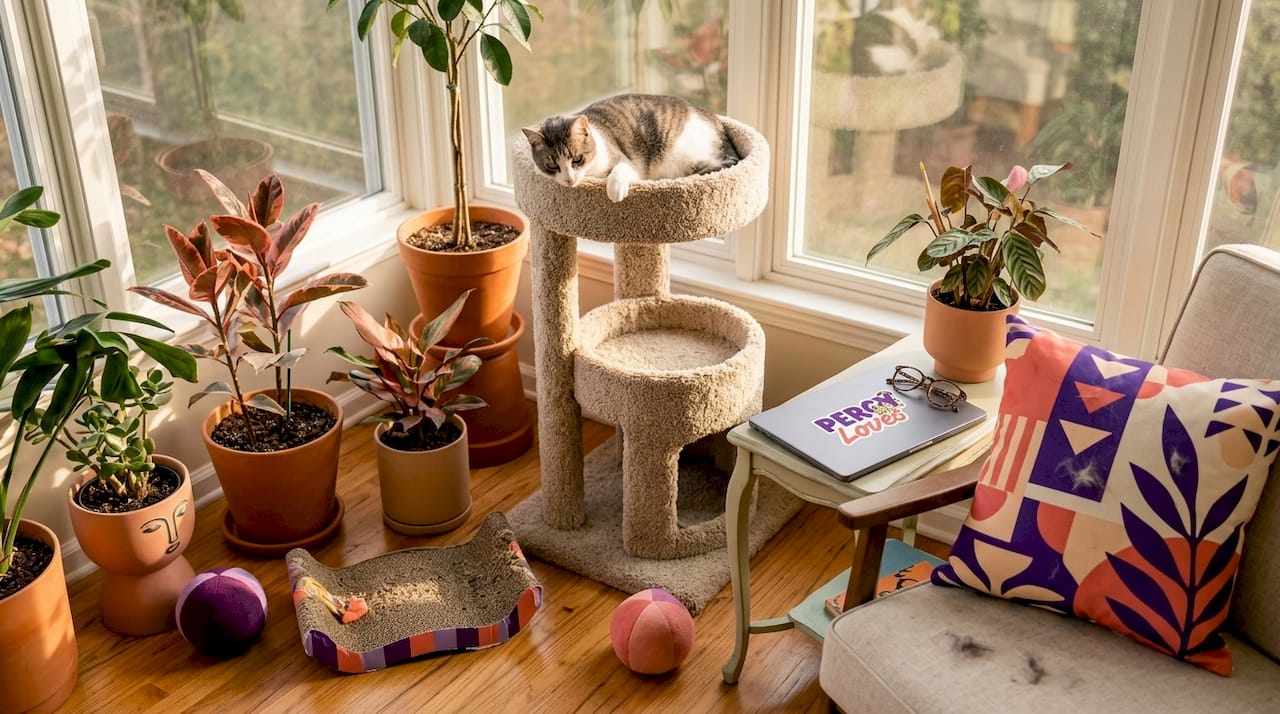
Here’s a quick reference for the core enrichment setup:
| Item | Purpose | Rotation needed? |
|---|---|---|
| Cat tree or wall shelves | Climbing and territory surveying | No |
| Scratching posts (vertical and horizontal) | Natural scratch behavior and nail health | No |
| Window perch near a bird feeder | Passive mental stimulation | No |
| Wand toys | Interactive predatory play | Yes, every 3 to 7 days |
| Puzzle feeders | Mental stimulation and slower eating | Vary difficulty monthly |
| Solo toys (balls, crinkle toys) | Independent play between sessions | Yes, every 3 to 7 days |
The toy rotation rule is one of the most underused indoor cat activities, and it’s free. Store unused toys in a bag with a little dried catnip or a worn t-shirt of yours. When you swap them back in, your cat encounters a “new” scent-loaded toy. Their interest resets almost immediately.
Toy variety is not about quantity. Three toys used cleverly beat fifteen toys left on the floor permanently. Keep it fresh and purposeful. Check out these healthy pet tips for more guidance on building a safe and enriching environment.
Pro Tip: Place at least two scratching surfaces near the spots your cat already scratches. Cats scratch to mark territory, not just to stretch. If you put posts in “out of the way” corners, they’ll ignore them entirely.
Make sure your setup is safe by reviewing cat safety tips before adding new climbing structures or play equipment. And use this cat health checklist to track how environmental changes affect their overall wellness.
With your home ready, it’s time to learn how to engage your cat daily with purposeful activities.
Execute an interactive play and mealtime enrichment routine
This is where the real transformation happens. A consistent daily routine is the single most effective thing you can do for an indoor cat. Not the most expensive toy. Not the fanciest cat tree. Consistency.
Two 10 to 15 minute wand toy sessions daily improve behavior noticeably within one week. That’s a real, measurable result you can see in your own cat.
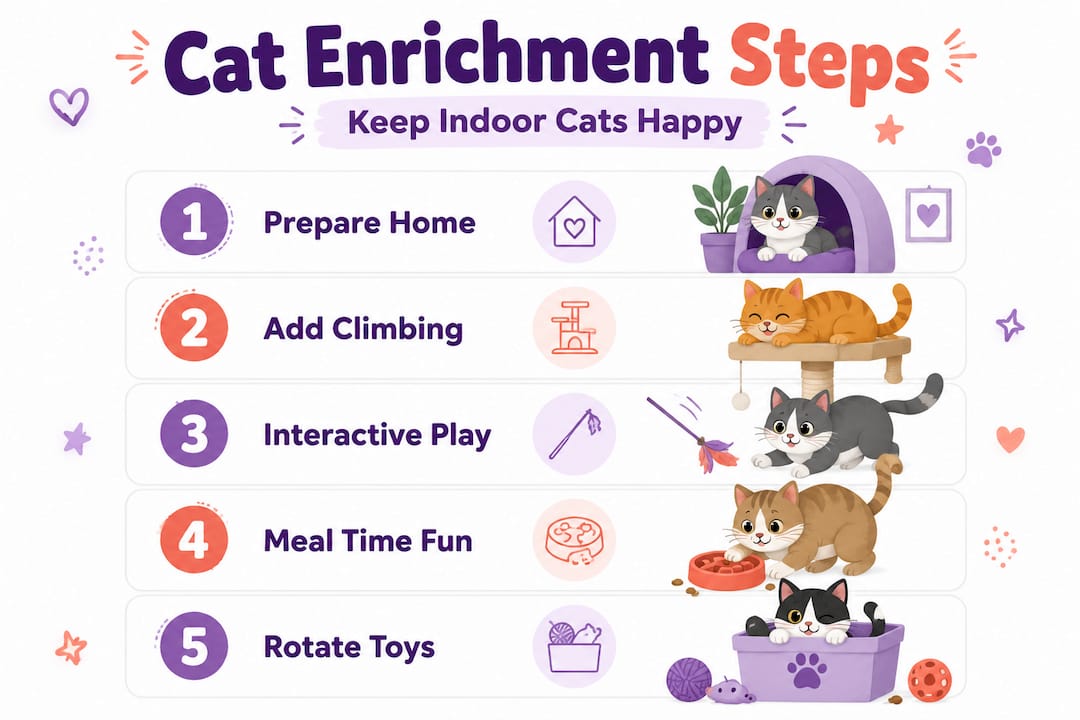
Here’s how to structure your daily play and feeding routine:
- Start with slow movement. Drag the wand toy low and slow, like a tired mouse. Let your cat stalk before they pounce.
- Vary the speed and direction. Real prey doesn’t move in straight lines. Dip behind furniture, flutter under a blanket, pause unpredictably.
- Let them catch it. This step is critical and we’ll cover it more in the perspective section. Let your cat grab and “kill” the toy before ending the session.
- Feed immediately after play. This completes the hunt-catch-eat cycle their biology expects.
- Add a puzzle feeder or lick mat at mealtime. Puzzle feeders and lick mats slow eating, reduce stress, and stimulate natural foraging instincts, according to Dr. Erin Ray from Texas A&M College of Veterinary Medicine.
- Hide small kibble portions in different spots around the home between meals to encourage natural foraging behavior throughout the day.
“The best thing you can do for your indoor cat isn’t the most expensive thing. It’s the most consistent thing.”
Pro Tip: Schedule play sessions around dusk and dawn when possible. Cats are naturally crepuscular, meaning most active at twilight hours. Play that aligns with their internal clock hits differently. You’ll notice more enthusiasm, faster engagement, and deeper satisfaction.
For more ideas on building daily routines that support your cat’s health and happiness, explore these essential pet care tips.
Now that you know how to engage your cat daily, let’s troubleshoot common pitfalls and maximize results.
Troubleshooting common challenges and maximizing enrichment benefits
Even with the best setup and intentions, you’ll hit walls. Cats are individuals. What works for one may bore another. Here’s how to read the signs and course-correct fast.
Signs your cat is frustrated or overstimulated during play:
- Tail thrashing or puffing
- Walking away mid-session with a stiff, low posture
- Sudden redirect aggression, swatting at you instead of the toy
- Pupils staying dilated after the session ends
When you see these signs, slow down or end the session with a calm “catch” moment. Do not push through. Overstimulation builds negative associations with playtime.
Signs your cat is genuinely bored between sessions:
- Excessive grooming or hair pulling
- Knocking things off surfaces for seemingly no reason
- Increased vocalization, especially at night
- Sleeping more than 16 hours a day consistently
Cats habituate quickly to toys used the same way. Rotating them and adding new interaction styles restores interest, according to 2026 cat behavior experts. Store a few toys away for a week, then reintroduce them with a new motion pattern. That alone can reignite your cat’s interest.
A few more solutions that work consistently:
- Avoid making the laser pointer your cat’s only play toy. It creates perpetual hunt frustration because there’s nothing to physically catch. Pair it with a physical toy to end every laser session.
- Add a cardboard box, a paper bag (handles removed), or a tunnel to create new hiding spots every few weeks. Novelty doesn’t require money.
- Place your worn clothing near their sleeping area. Your scent is genuinely calming to cats who are bonded to you.
Pro Tip: Adjust your play session timing based on your cat’s energy patterns. Observe for two days when they naturally become most active. Schedule sessions there and you’ll get dramatically more engagement with far less effort.
Keep your home comfortable and odor-free while managing an active play environment by reading these pet odor control tips.
With these solutions in mind, you’ll soon see positive changes. Here’s what to expect when enrichment is done right.
Expected results: happier behaviors and improved well-being
When you consistently apply what’s in this guide, you will see real changes. These aren’t gradual, barely-noticeable shifts. Most owners report visible improvements within a week.
Here’s what a well-enriched indoor cat looks like:
- Less destructive behavior. Scratching furniture, chewing cords, and knocking things over all decrease when cats have appropriate outlets for their energy.
- Calmer demeanor. Stress and anxiety drop noticeably. Your cat will seem more settled, especially in the evenings.
- Stronger bond with you. Cats that play interactively with their owners show behavioral improvements within a week and become noticeably more affectionate and engaged.
- Healthier weight. Active indoor cat activities support metabolism and mobility, especially in cats prone to sedentary weight gain.
- Better sleep. Cats who complete proper hunting cycles sleep more deeply and at more predictable times, which means quieter nights for you too.
These are not minor quality-of-life upgrades. They represent a fundamentally healthier, happier animal. Track changes using a simple cat health checklist to monitor progress over time.
Having seen the benefits, here’s a fresh perspective on indoor cat entertainment few people discuss.
Why the hunt cycle completion is the secret to truly satisfying play
Most cat owners play with their cats. Fewer understand how to end that play in a way that actually satisfies the cat’s instincts. This is the detail that separates mediocre playtime from genuinely fulfilling enrichment.
In the wild, a cat’s day revolves around a predictable loop: stalk, chase, catch, kill, eat, groom, sleep. That sequence has a biological finish line. When you play with a wand toy and then just put it away, you’re stopping the loop before it finishes. Your cat’s nervous system is left hanging. That’s why some cats get amped up and aggressive right after play. The hunt didn’t close.
Ending play by letting your cat “catch” the toy and feeding immediately after fully satisfies their instincts, according to 2026 enrichment routines. It sounds almost too simple, but it changes everything.
What this looks like in practice: slow the toy down, let it go still, allow your cat to grab it and bunny-kick it. Let them hold it for a moment. Then put the toy away and immediately offer their meal or a treat. That sequence tells their brain: hunt complete, reward received, rest now.
We at Percy Loves have seen this firsthand with our own fur families. The cats who get the full cycle are calmer, sleep better, and are more affectionate overall. The ones who get abruptly ended play sessions are the ones pacing the hallway at 2 a.m.
Practice slow, unpredictable movements during play too. Real prey doesn’t sprint endlessly. It hides, freezes, darts, and tires out. Matching that pattern builds deeper engagement than any toy on the market. Make sure your play setup is always safe by revisiting cat safety tips at home before introducing new props or structures.
Discover Percy Loves Pal Furresher: safe odor control for your active indoor cat home
As you build out this vibrant enrichment routine, your home is going to smell like a happy, active cat lives there. Scratch posts, litter boxes, play zones, and cozy corners all accumulate odors. Percy Loves is here to handle that without compromising your cat’s safety.

Pal Furresher is our fragrance-free, enzyme-free odor elimination spray that tackles pet odors at the source. It doesn’t mask them. It eliminates them completely. And because it’s lick-safe and contains no harsh chemicals, you can use it confidently around even the most curious, mouth-everything cats. Grab the travel-friendly 4 oz Pal Furresher for spot treatment during play sessions, or stock up with the Pal Furresher pack of 3 so you’re always covered. Because your home should smell as good as your cat feels.
Frequently asked questions
How often should I play with my indoor cat each day?
Aim for two to three interactive play sessions daily totaling 30 to 60 minutes to mimic natural hunting behavior and prevent boredom-related issues.
What types of toys are best for entertaining indoor cats?
Wand toys that mimic prey movement are the most effective because they complete the hunt cycle; puzzle feeders and a rotating selection of solo toys round out a strong enrichment setup.
Can puzzle feeders really reduce my cat’s stress?
Yes, puzzle feeders and lick mats slow eating, stimulate natural foraging behaviors, and reduce anxiety in indoor cats, according to Dr. Erin Ray from Texas A&M College of Veterinary Medicine.
Why is toy rotation important for my cat?
Cats habituate quickly to familiar toys; rotating them every few days restores novelty and keeps your cat genuinely engaged rather than just glancing and walking away.
Is it safe to let my cat watch birds outside a window?
Yes, a stable window perch near a bird feeder provides daily mental stimulation and enrichment; just make sure window screens are securely fastened so your cat can’t push through them.


